The cylinder
We establish your hot-water routine and existing heat source, then assess the cylinder, immersion and safety controls. You find out whether EDDI is a suitable addition before it appears in your quote.
FENNOR / EDDI HOT-WATER DIVERSION
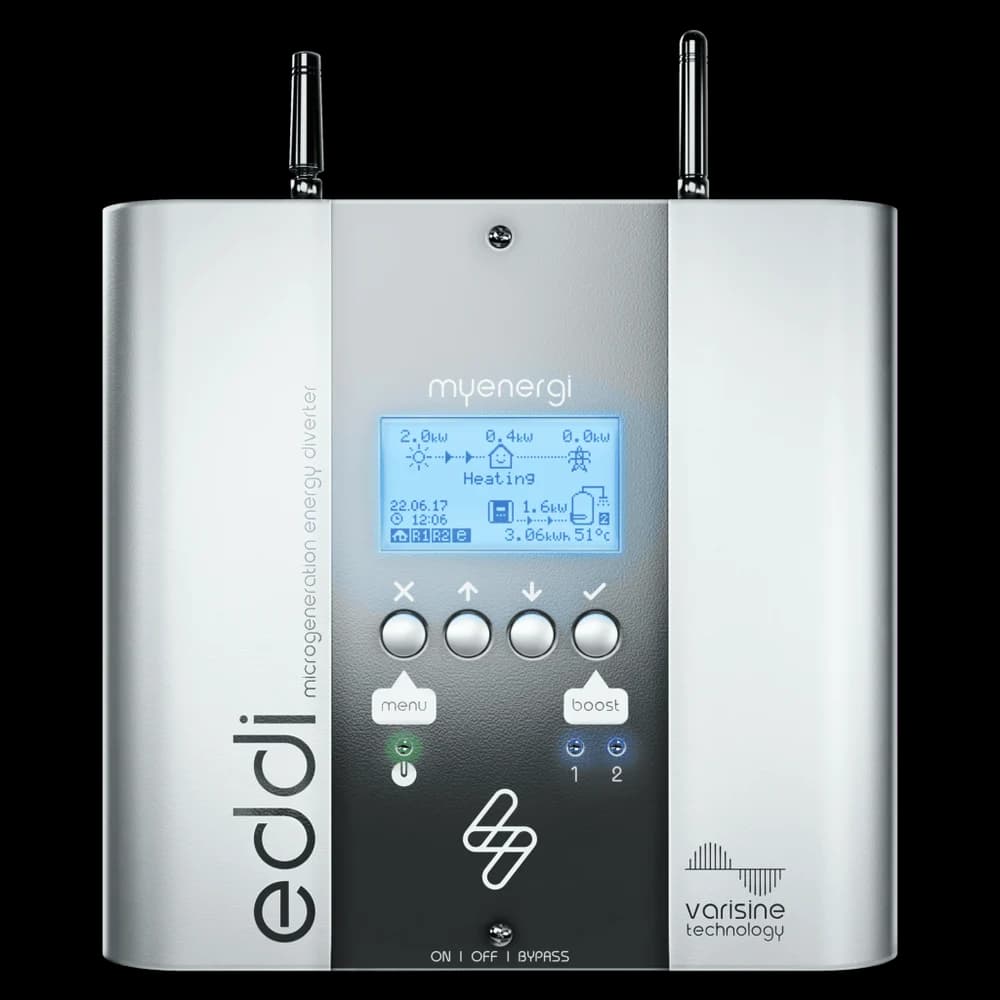
Put spare solar electricity towards the hot water you use at home. Fennor helps you work out whether EDDI suits your cylinder and where it fits alongside a battery, charging or export.
HOT WATER / A DIFFERENT KIND OF STORAGE
A cylinder stores heat. A battery stores electricity. They can work within the same home, but they do not do the same job.
After the home’s immediate electrical demand, available surplus can be directed to a compatible immersion. EDDI modulates that heating load within the equipment and cylinder limits.

MAKE THE EXTRA EARN ITS PLACE
An EDDI conversation starts with how water is heated today. A household with regular cylinder demand and spare daytime generation has a different opportunity from one with no cylinder or very little surplus.
It also needs the whole energy picture. Diverting a unit of electricity means that unit cannot simultaneously charge a battery, charge the car and earn an export payment.
Already considering a heat pump? ↗THE INSTALLATION CONVERSATION
We establish your hot-water routine and existing heat source, then assess the cylinder, immersion and safety controls. You find out whether EDDI is a suitable addition before it appears in your quote.
We identify any existing battery or smart charger and assess how the equipment measures electricity flow. Your proposal explains the compatible controls and any extra work needed to connect them.
Together we agree whether hot water, the battery or your car takes priority. At handover, the installation team demonstrates normal operation and a grid-powered boost, including when it uses paid electricity.
ONE SURPLUS. DIFFERENT PRIORITIES.
Illustrative allocation, not a live controller or a promise of product interoperability. Fennor assesses compatibility and explains how your chosen priority would work. The installation team configures the agreed controls and demonstrates them at handover.
In this example the immersion takes 2 kW, with 1 kW available for the battery. When the water reaches its target, priorities need to move on. Actual allocation depends on the connected controls.
The allocation totals 3 kW in every example. No energy is counted twice. Export remains another option; these examples assume the full surplus can be accepted.
YOUR PROJECT WITH FENNOR
We explain the choices, the work involved and what happens next, so you can decide with a clearer picture.
EDDI adjusts a compatible resistive heating load to use available surplus. myenergi specifies diversion up to 3.7 kW. We explain how that differs from switching on a full-power immersion; the existing cylinder thermostats and safety controls remain essential.
We ask about the cylinder, immersion and how your household uses water. The electrical assessment then establishes compatibility, grid-flow measurement and installation details. We explain the work and cable routes before you choose the accessory; a home without a cylinder is not an automatic fit.
We compare water-heating value with the export payment you would give up. Where you have a battery or EV, we include those needs too. Correctly coordinated controls prevent unintended battery draining, and a heat pump may heat water more efficiently than an immersion.
A SIMPLE START
MORE WAYS WE CAN HELP
SUPPORT FOR THE WORK YOU HAVE IN MIND
These are the relevant funding options to discuss with Fennor alongside your project. We explain the full price, the support that may apply and the steps before you commit.
Reviewed · Guidance, not an eligibility decision.
Funding explained
No separate listed grant
The current individual-grant list does not list a dedicated EDDI diverter or changeover-switch grant. We price these additions separately.
Grant support
€1,200
This supports eligible solar-thermal collectors that heat water. It is not the grant for solar PV or an EDDI diverter.
USEFUL ANSWERS
Plain language. No pressure to have it all figured out.
No. Its contribution depends on surplus, season and water use. A boost can import electricity, and power used for water cannot also be exported. We explain those trade-offs using your household’s routine.
Potentially. We review the equipment details and explain the required compatibility and control checks. The installer then establishes the measurements and priorities; an on-screen energy flow is not a wiring design.
Often. We start with the cylinder, solar equipment and electrical installation, then explain the assessment and installation work needed for a suitable addition.
LET’S TAKE THE NEXT STEP
Based in Slane, serving Meath, Louth and Dublin. Tell us about a project further afield and we will confirm whether we can help.
089 403 2737 ↗info@fennor.ieWe will confirm the next step, availability and any assessment cost with you before a visit is booked.