Keep your land working.
A suitable shed roof offers space for panels without turning grazing or cropping land into a ground-mounted array. Structure, condition and access still come first.

FARM SOLAR / FENNOR
Solar for the shed.
Value for the whole farm.
Put suitable roof space to work generating electricity for the loads behind your farm’s bill—while keeping the land in production.
Explore my farm’s potential ↗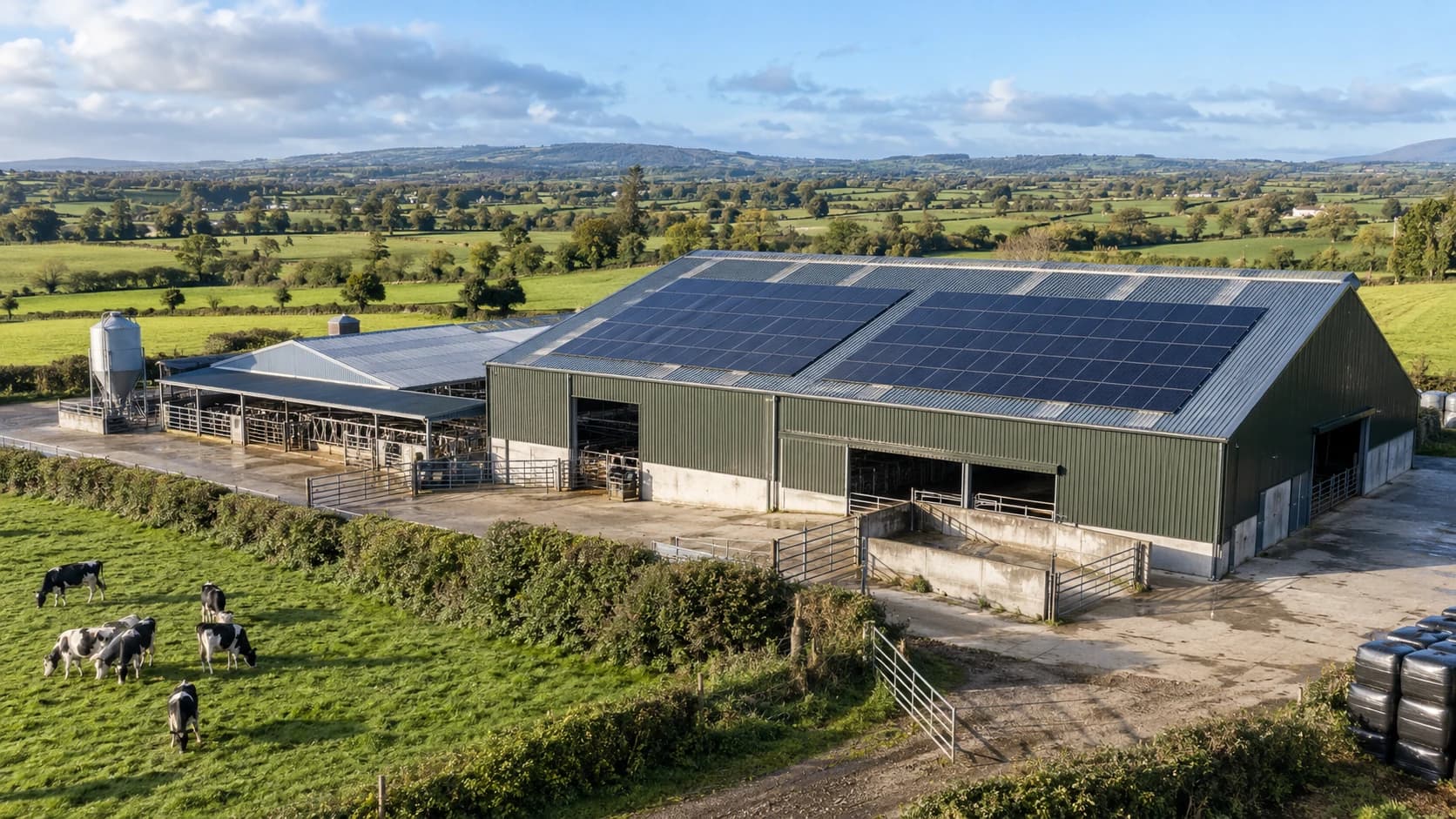
AN ASSET YOU MAY ALREADY HAVE
Roof first. Farm always.Fennor matches the array to the farm’s working loads, with a clear view of the installed cost, available support and practical effect on the yard.
A suitable shed roof offers space for panels without turning grazing or cropping land into a ground-mounted array. Structure, condition and access still come first.
Electricity used directly on the farm can displace grid purchases at that time. Cooling, pumps and other daytime loads are worth examining against actual meter data.
We look at efficient use of electricity before sizing the array, then explain likely self-use, export and whether storage adds useful value for the farm.
THE DAIRY ELECTRICITY PICTURE
In Teagasc’s reported dairy energy research, milk cooling, water heating and milking together accounted for 80% of electricity use. Those are useful loads for us to assess against your meter data—not an 80% solar saving.
Read the Teagasc research ↗Cooling + hot water + milking
Research breakdown · not every farm
Other uses is the remaining share. Your own breakdown depends on equipment, management and production system.
02 / EVERY FARM HAS ITS OWN RHYTHM
Choose your enterpriseLook beyond the annual bill. The hours—and months—you use electricity shape the opportunity.
Dairy / THE WORKING PATTERN
Early milking starts before strong solar output. Cooling and other daytime loads can offer a better overlap; evening demand needs its own assessment.
Across the year. Spring-calving demand can align with brighter months. Winter-calving needs a different seasonal model.
TIMING MATTERS AS MUCH AS ROOF SPACE
Conceptual demand only. Shading marks daytime—not a generation forecast. Real patterns vary by season, weather and equipment.
We use your milking times, bulk-tank details and a full year of electricity use to assess the fit.
Let’s look at your farm ↗A seasonal advantage worth investigating. A 2026 Teagasc–Maynooth modelling study of two Galway dairy farms found stronger solar–demand alignment for the spring-calving case. It is a useful insight, not a predicted return for your farm.
Explore the study ↗03 / MAKE THE NUMBERS MEAN SOMETHING
Interactive illustrationMove the self-use slider. See how electricity used on the farm and electricity exported contribute differently.
EDIT THE ASSUMPTIONS
Starting figures are examples, not Irish average tariffs or a prediction for your farm. Use rates on a consistent VAT basis.
Fennor prepares a roof-specific generation estimate following assessment; use it here when available.
Enter rates from 0–200 cent/kWh. Use zero export value if no payment is assumed.
ILLUSTRATIVE ANNUAL GROSS ENERGY VALUE
Avoided electricity purchases + potential export income.
Not net savings or payback. Excludes installation, finance, maintenance, replacements, tax and battery losses. Assumes the remaining generation can be exported; curtailment and export limits can reduce the result. Standing charges remain. Self-use must be supported by demand at the time of generation.
Turn assumptions into a farm-specific assessment ↗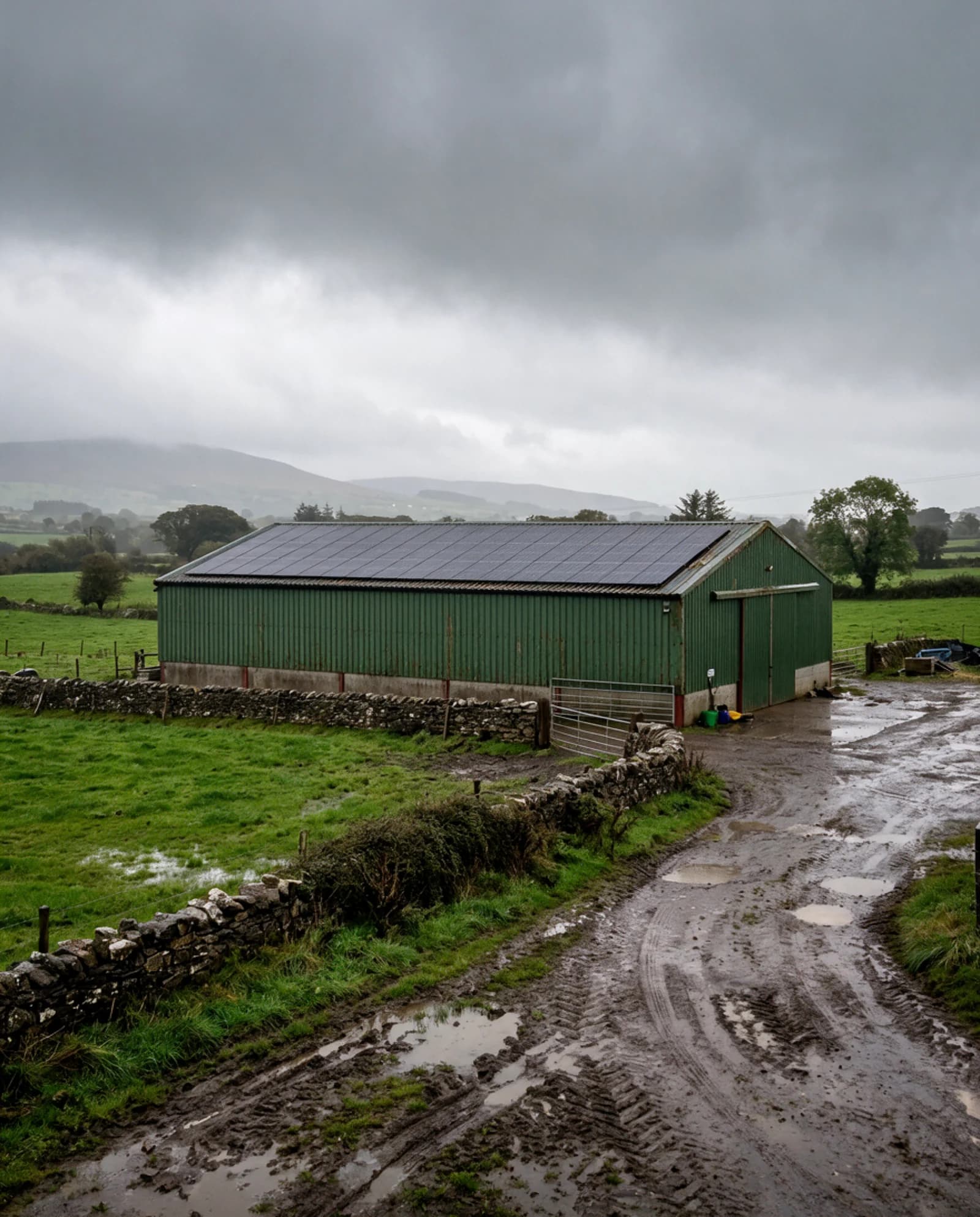
THE SHED IS ONLY THE START
Show us the buildings you have in mind from ground level. We arrange assessment of the structure, roof condition, fragile materials and access, then explain any roof work needed before an array is proposed.
Your daily farm routine sets the practical constraints. Fennor plans access around animals, deliveries, silage, machinery and biosecurity, with any necessary electrical shutdown agreed before work is scheduled.
The electrical assessment establishes the meter, supply capacity and grid connection route. We explain what that means for your array and export; panel capacity in kWp is not the same as inverter capacity in kVA.
At handover, Fennor explains the monitoring, warranties, records and support contact. Critical farm loads are identified early so any separate backup design can be assessed without replacing your existing outage plan prematurely.
04 / FIND THE RIGHT SUPPORT
Sources checkedFennor develops the technical proposal and explains the figures behind it. Your farm adviser handles the scheme advice and application route with the administering body; we identify the system information they need before you commit.
DAFM / TAMS 3
of approved eligible expenditure
€54,000 is the arithmetic maximum on the stated ceiling, not an automatic award or 60% of every quote. Previous support and eligible-cost rules can reduce it.
SEAI / NON-DOMESTIC MICROGEN
of eligible invoiced PV cost, with a size-based cap
Payment is the lower of the system-size allowance or 45% of eligible cost. The maximum is not a typical farm award. Existing offers are not uplifted.
DAFM’s current sizing rules exclude dwelling demand. Where a dwelling shares the MPRN, the June 2026 terms require a 4,200 kWh deduction per dwelling from annual usage for grant sizing. This is a scheme calculation—not a measured household average. Your adviser applies the current demand-sizing rules, using the technical system information from the proposal.
Read the DAFM update ↗Plan the application. DAFM’s published calendar lists 4 December 2026 for Tranche 14. Reconfirm the closing date and current selection arrangements before applying; dates can change. Check the DAFM calendar ↗
Plan the cash flow. Grant support is not an upfront discount. Fennor explains the full invoice and payment stages; your adviser clarifies eligible costs and reimbursement timing so the funding gap is visible. The same investment must not be claimed under both routes.
05 / STRAIGHT ANSWERS, INSIDE THE FARM GATE
From the roof to the milking parlour, these are the details worth settling early.
Teagasc’s dairy solar guide ↗The guide is from 2025. Use the 2026 funding updates above for current grant changes.
Potentially. Fennor arranges assessment of the roof covering, structure, fixings, shading and safe maintenance access before a layout is agreed. Rooflights and ventilation must remain functional. Suspected asbestos needs specialist assessment; do not disturb it or climb onto a fragile roof. Ground-level photographs are enough for an initial conversation.
What we check on the farm ↗Not automatically. SCIS supports approved eligible expenditure at 60%, within its investment ceiling. The grant calculation is subject to DAFM reference costs, eligible paid costs excluding VAT and the submitted application cost. Ranking and selection means an application is not an approval. Fennor explains the full installation price, while your adviser establishes the eligible grant calculation. You can see the funding gap before committing.
Teagasc’s October 2026 funding guidance ↗Do not assume that you can combine them. They are separate funding routes with restrictions on other public funding. Fennor explains the technical proposal and available routes; your farm adviser and the administering body establish the appropriate application before you commit to the investment.
Compare the two routes ↗DAFM’s 2026 announcement restricts new solar support to on-farm energy consumption. We do not include dwelling demand when sizing a new farm application. If the house and farm share a meter, your adviser establishes the separate usage for the application, supported by the technical proposal. Home solar has a separate SEAI route.
Read DAFM’s on-farm demand update ↗Ordinary grid-connected solar is not backup power. A battery alone is not a guarantee either. Essential loads need a separately designed backup arrangement with compatible equipment, safe isolation and sufficient power and capacity. Keep your existing contingency plan until a qualified contractor has confirmed the design.
Understand storage and backup ↗Fennor compares the options against your actual surplus and load timing. Batteries add cost and losses. Hot-water control must preserve the temperatures and timing needed for dairy hygiene; do not alter wash routines just to use solar. We explain direct daytime use, suitable storage and export without counting the same electricity twice.
Explore hot-water diversion ↗Potentially, subject to the connection, metering and supplier’s export arrangements. Fennor explains the proposed connection and export limits; your electricity supplier confirms its export tariff. We do not base your investment case on an assumed guaranteed rate. The value explorer lets you enter your own rate, including zero.
Check the network connection route ↗Some rooftop installations may qualify for an exemption, but conditions and site restrictions still apply. Protected structures, safeguarding zones, ground-mounted arrays and associated works can require additional checks. Fennor identifies the planning questions for your site, with the planning authority confirming the position before you commit.
Read Teagasc’s solar guide ↗START WITH THE FARM, NOT A PANEL COUNT
Fennor is based in Slane, serving Meath, Louth and Dublin. Agricultural projects elsewhere in Ireland can be considered individually.
089 403 2737 ↗info@fennor.ieStart with the farm location and your priorities. If available, 12 months of bills, ground-level shed photographs, meter details and any grant application status help us prepare the assessment. No need to climb onto a roof.