Keep daylight for later.
Use some of the solar you would otherwise export during your evening routine. Direct daytime use still avoids the extra losses of storage.

HOME BATTERY STORAGE / FENNOR
Keep more of your solar electricity for the hours that feel like home. Storage, thoughtfully matched to the way you live.
See your energy differently ↓SOLAR DOESN’T HAVE TO END AT SUNSET
A battery can keep spare daytime electricity for your evening routine. Fennor compares your demand, available solar and tariff so you can see where storage adds value—and where it may not.
Use some of the solar you would otherwise export during your evening routine. Direct daytime use still avoids the extra losses of storage.
Compatible controls can use lower-priced charging periods. The whole tariff, efficiency and your actual demand determine the benefit.
If power cuts are a concern, we include your essential appliances in the initial assessment. A battery on its own is not a promise that the house stays on in an outage.
01 / A DAY, RECONSIDERED
Choose a moment belowFrom a sunny afternoon to a busy evening. Explore what a connected solar-and-storage system can do.
Solar supplies the home first. Where generation exceeds demand, compatible controls can charge the battery; any further surplus may be exported.
Solar → home + battery
Illustrative sequence, not live monitoring or a forecast. Times, charge levels and energy availability vary.02 / BUILT AROUND YOUR USE
Not simply the biggest batteryUNDERSTAND THE TWO NUMBERS
10 kWhPublished usable energy
LUNA2000-10-S0 example
5 kWPublished battery maximum output
not a promise of whole-home backup
Huawei’s S0 datasheet lists 5, 10 and 15 kWh configurations. Actual delivery depends on operating conditions, reserve settings and the complete system. A 5 kW inverter does not turn the 5 kWh S0 battery’s 2.5 kW battery-output limit into 5 kW.
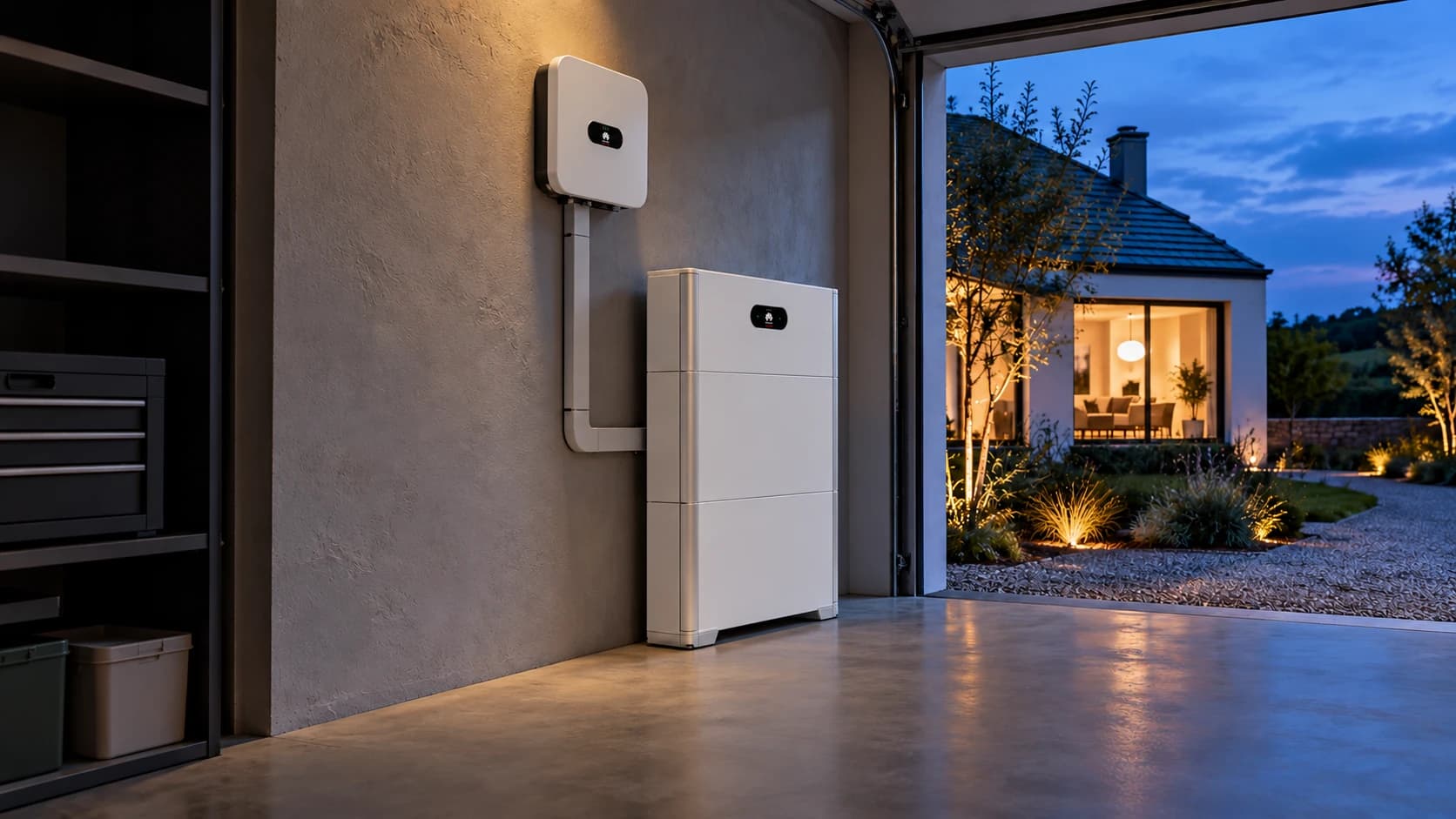
The illustration shows the LUNA2000 S0 family with a SUN2000-5KTL-L1 inverter. Fennor names the proposed model, confirms availability and explains its compatibility and installation arrangement in your proposal. This is not a claim of manufacturer endorsement.
Start with your evenings. We use your half-hourly demand, where available, to match storage to your evenings and the spare solar likely to be available across the year.
Know what you can use. We explain usable energy, continuous power and warranty terms together, including how reserve settings and operating conditions affect what is available.
Keep tomorrow in view. A planned EV or heat pump changes the picture. We explain compatible expansion options so you can decide what you need now and what could wait.
03 / UNDERSTAND THE DIFFERENCE
Editable illustrationStoring solar gives up potential export income. Charging from the grid has a purchase cost. This comparison includes both—and energy losses.
One illustrative charge/discharge event. These are editable assumptions—not typical tariffs or a daily promise. Use a consistent VAT basis.
Input limits: 0.1–50 kWh, 50–100% efficiency and 0–200 cent/kWh. Use a system-specific efficiency estimate, not the example as a Huawei specification.
ADDITIONAL ENERGY VALUE / EVENT
The tariff difference leaves value after energy losses.
Not net savings or payback. Excludes installed cost, finance, maintenance, degradation and replacements. Assumes enough usable capacity and charging time, and all returned energy replaces imports at the entered rate. Real demand, reserve settings and power limits can reduce the result. No annual multiplication is assumed.
Technical background only; UK grant and export schemes do not apply in Ireland.
04 / RESILIENCE, DESIGNED IN
Not automatically.
But it can be designed to help.
A grid-connected solar system normally disconnects during an outage. Backup requires compatible equipment, safe grid isolation and a plan for the circuits you want to support. Fennor helps you identify the essentials, then a Registered Electrical Contractor assesses the equipment, supported circuits and safe changeover arrangement.
SEAI: solar during a power cut ↗START WITH WHAT MATTERS TO YOU
Potential priorities—not a guaranteed supported-load list. Starting currents, simultaneous loads, battery charge and inverter limits all matter.
What can run at once.
kWhHow much energy is available.
Do not assume whole-home backup or uninterrupted power. Switching behaviour and runtime are system-specific. Medical or other critical equipment needs a separately agreed contingency plan.
What we need to understand before recommending storage.
We identify your inverter, supply phase, monitoring and available capacity, then explain whether storage can work with your existing solar or requires changes.
We assess the available spaces for access, clearances and equipment requirements, then agree a suitable location with you. The scene above is illustrative.
We will explain the proposed models, usable capacity, power limits, controls and full installed price. Any backup provision and warranty conditions will be set out separately so you know what is included.
At handover, we show you how to use the system and monitoring, explain its operating limits, and provide the relevant electrical records and contacts for faults or warranty questions.
05 / SUPPORT WITH CONDITIONS
SEAI guidance checked . Confirm current terms before committing.
Flat-rate support for eligible systems of 5 kWh or larger.
Maximum standard solar PV support of €1,800 plus an eligible €600 battery grant. Not a €2,400 battery-only grant; eligibility applies to each measure.
Check the standard solar PV grant ↗06 / CLEAR ANSWERS
Useful guidance, without the hard sell.
Often, but compatibility comes first. Fennor identifies your inverter and existing equipment, using system paperwork and usage data where available. We explain what can stay, any equipment changes and who supports the combined system before you choose.
No. kW is power: the rate of supplying electricity. kWh is energy: the amount stored. A larger battery may run suitable loads for longer without increasing the inverter’s output limit. We explain both figures in your proposal, including the limits that apply in backup mode.
No. Capacity that rarely fills or rarely discharges may add cost without useful value. Fennor compares your spare solar, evening demand and charging tariff across different seasons. Meter data helps us explain whether extra capacity would be useful or simply add to the price.
A compatible system can charge from the grid during a lower-priced tariff period. The price difference must cover storage losses and other costs. We compare the whole tariff, charging window and equipment settings with you—not just the cheapest advertised unit rate.
At the configured upper limit, charging stops. Solar surplus may go to other loads or export, subject to settings and connection limits. At the minimum reserve, discharge stops; in normal grid-connected operation, the grid can supply the remaining demand. During an outage, supported loads stop if backup energy runs out.
It may contribute, but those loads can be substantial. We assess simultaneous power demand, energy required, inverter limits and control priorities before recommending how those loads fit into your system. Charging an EV directly from available solar or an appropriate grid tariff may make more sense than passing that electricity through a house battery.
Fennor assesses your existing setup and what you want storage to do, then explains an installed quote covering any inverter changes, controls, electrical work, backup provision, VAT and support. You can review the extra cost alongside a solar-only option. The examples on this page are not equipment prices or a payback forecast.
No. SEAI’s battery support has separate conditions. The current amounts and key requirements are set out in the grant section below. Fennor explains the application steps and required contractor inputs; SEAI determines eligibility and must issue the offer before work starts.
View the grant conditions ↑A BATTERY SHOULD EARN ITS PLACE
Whether you want to use more solar, shift cheaper electricity or plan for outages, we start with your current system and daily routine. Your next step is an assessment, followed by an explained storage option and full installed price.
Based in Slane, serving homeowners in Meath, Louth and Dublin. Farm and commercial storage enquiries are assessed individually.
089 403 2737info@fennor.ie ↗